About me
The things people usually sweep under the rug are welcome here too.
People often come to me because something is stuck. The same argument ends the same way for the tenth time. Trust has cracked. They no longer know whether the relationship still has a future. Or there are feelings that have had nowhere to go for a long time.
Jealousy, shame, anger, sex, affairs, withdrawal, thoughts of separation – including the things that are hard to say out loud. We can start there.
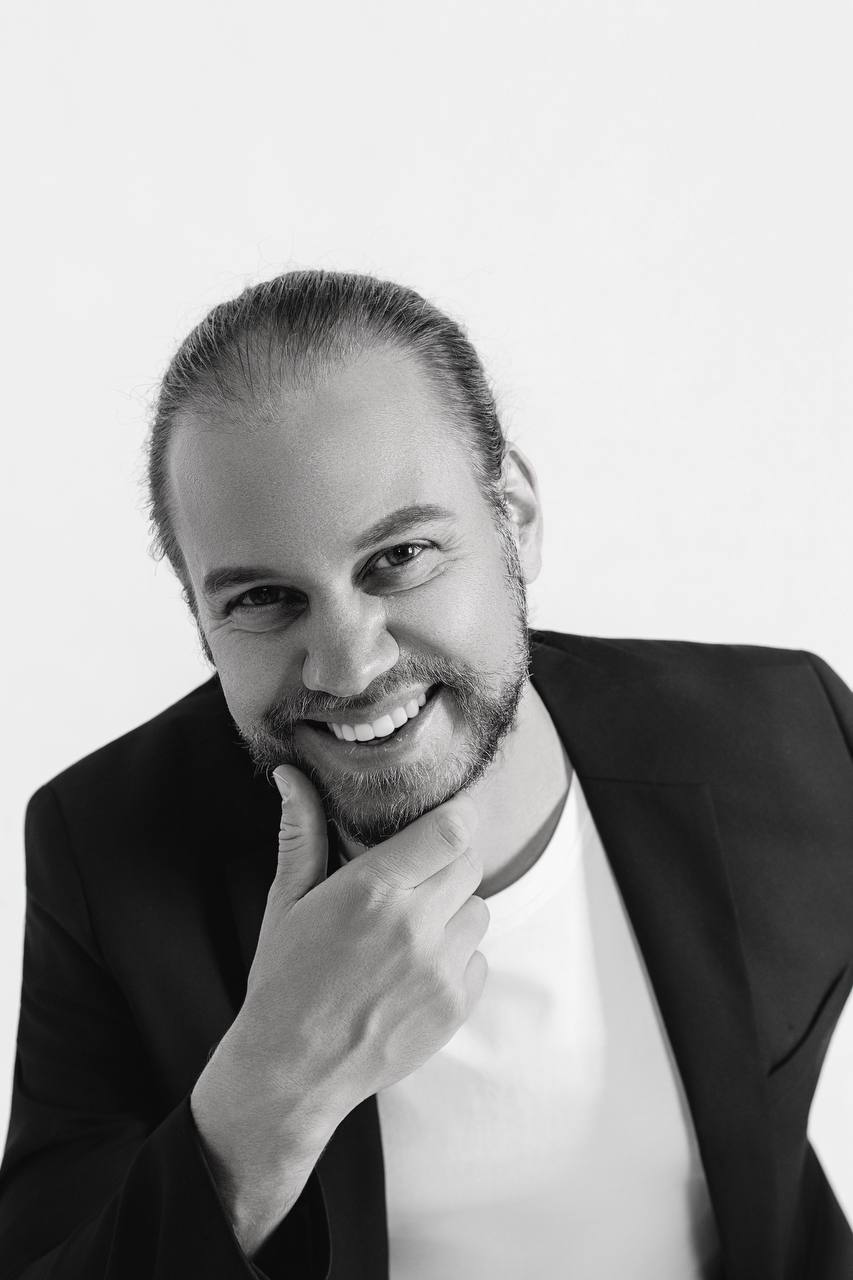
How I work
I listen. And I tell you what I see.
I listen to what is being said and to the sequence underneath it. Where does a conversation tip? Who pulls away? Who starts pushing harder? Who carries too much? What stops being said altogether?
When I see a pattern, I name it. Clearly, without putting you on display. Difficult things are allowed to be difficult. We look at them properly.
I want you to be able to speak honestly. That includes mixed feelings, things you are ashamed of and moments when you genuinely do not know what you want.
Who you'll be talking to
Theophil Kroller
I am a psychosocial counsellor and founder of Beziehungsdynamiken. My focus is relationships – in individual sessions, with couples, and with people in open, polyamorous or still undefined relationship constellations.
My thinking is shaped by research and academic work. In the room, my first concern is much simpler: understanding what is actually happening for you or between you, and what can change.
What matters to me
I like clear conversations. I ask again when something does not quite add up. I can stay with anger, hurt, uncertainty or shame. And I value humour when there is room for it again.
You can come on your own even when the issue is a relationship. You can come as a couple. If your relationship includes more than two people, or you are still working out what form fits you, that belongs in the room just as naturally.
Life path
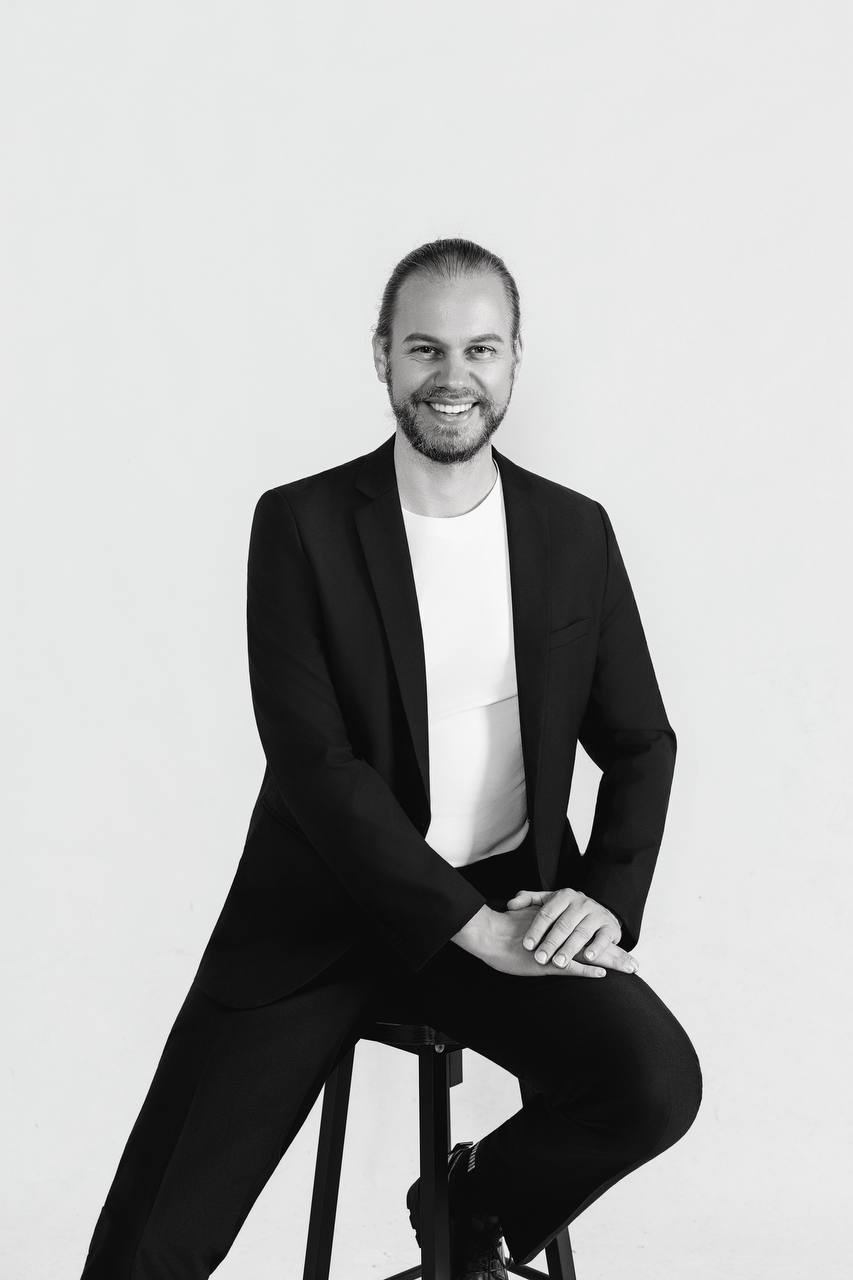
A path shaped by different directions.
I have lived in different countries, worked across different fields and professional roles, and I am a father of two. These experiences have shaped how I look at people, relationships and change.
I know what it is like when an old picture of your life no longer fits and you have to work out what still belongs and what does not.
That is probably one reason I am cautious with quick judgments about how a life should look. I am more interested in how someone arrived where they are now – and what may be possible from here.
What has shaped my perspective
Curious about people and the worlds they live in.
I spent a year as a high-school exchange student in the United States with an African American family, studied Sinology, lived in China for two years and in Japan for half a year. Longer trips through Latin America, Africa, Tibet and Australia added more perspectives.
Curiosity about people and different ways of living has stayed with me for a long time. Family, closeness, belonging, responsibility and boundaries can mean very different things to different people. In counselling, I would rather ask one more question than assume I already know what something means for you.
What keeps me moving outside work ⌄
I like things you can really get into – sometimes literally. Travel, diving, dance, martial arts and languages have been part of my life for a long time.
On the road
China, Japan, Australia, Tanzania, Latin America and Tibet are among the places where I have lived or spent more substantial time. What draws me to travel is immersing myself in different ways of life and seeing familiar things with fresh eyes for a while.
Under water
I have been scuba diving for many years. In 2026 I dived on the Great Barrier Reef – one of those experiences that stays with you. What fascinates me underwater is the quiet – and that very immediate sense of being connected to something elemental. Maybe that is part of what moves me about the sea: life itself began there.
Dance & movement
I dance Brazilian Zouk, Kizomba and Ballroom, and I have practised Bujinkan Budo Taijutsu for several years. What I enjoy in both dance and Bujinkan is the presence: being fully there and responding to what is happening in the moment. Dance brings playfulness, creativity, spontaneity, emotion and encounters with other people. Bujinkan is more physical and powerful – and there too, much of the experience comes from direct contact with another person.
Languages
I enjoy learning languages because they open another way into people and culture. Mandarin has been with me since my Sinology studies; I have also returned to Spanish and Japanese at different points.
Relationship diversity
Relationship diversity is part of my work.
My master's thesis focused on counselling in the context of relationship diversity. Open and polyamorous relationships have their own contexts, while the underlying themes are deeply human: safety, freedom, jealousy, commitment, boundaries, communication and belonging.
Training & qualifications
My qualifications
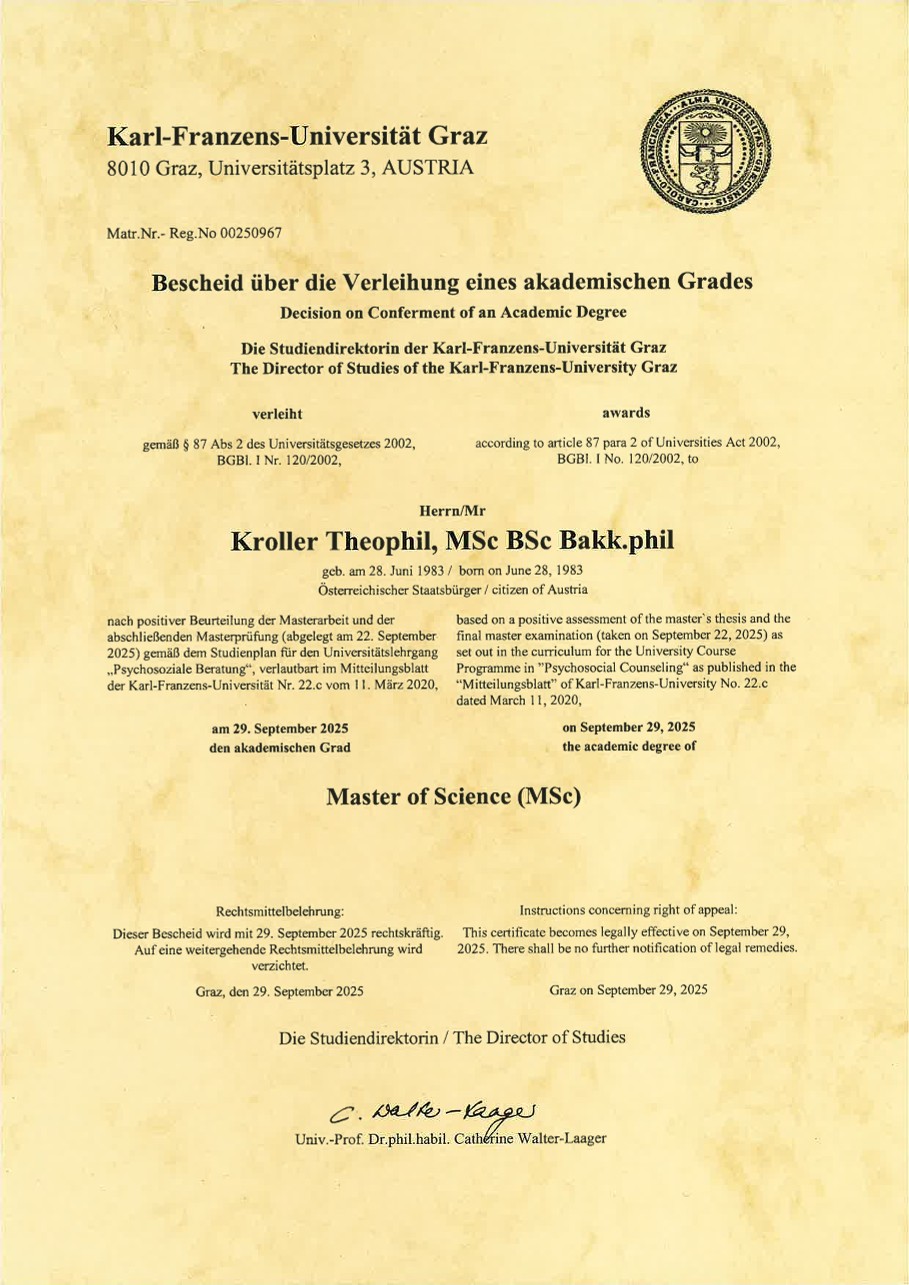
Academic degree
Master of Science – Psychosocial Counselling
Advanced academic work in psychosocial counselling. My master's thesis focused on counselling in the context of relationship diversity.
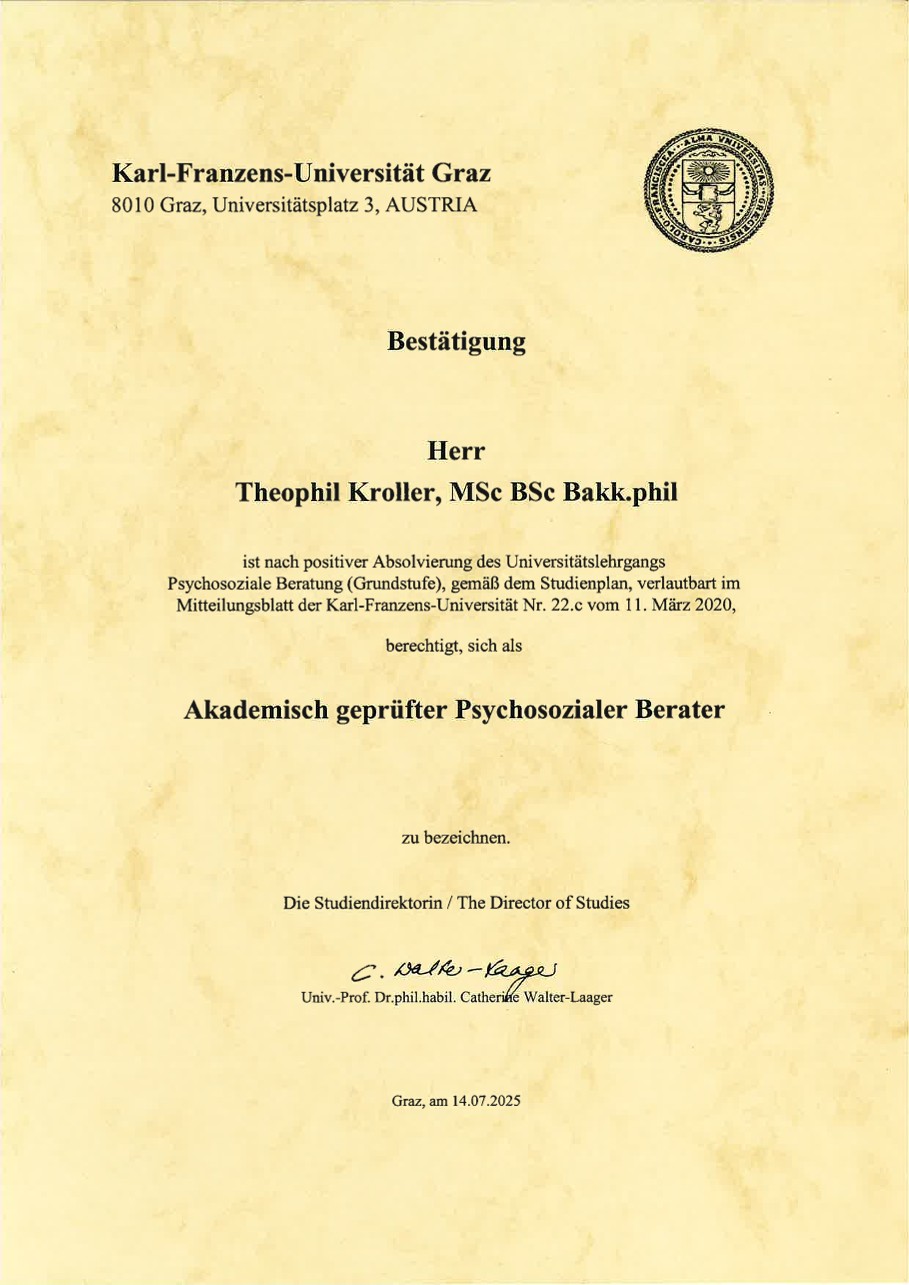
Counselling training
University-certified Psychosocial Counsellor
University training in psychosocial counselling, including humanistic, systemic, psychodynamic and cognitive-behavioural perspectives, practice, ethics and crisis intervention.
Further training in relationship work
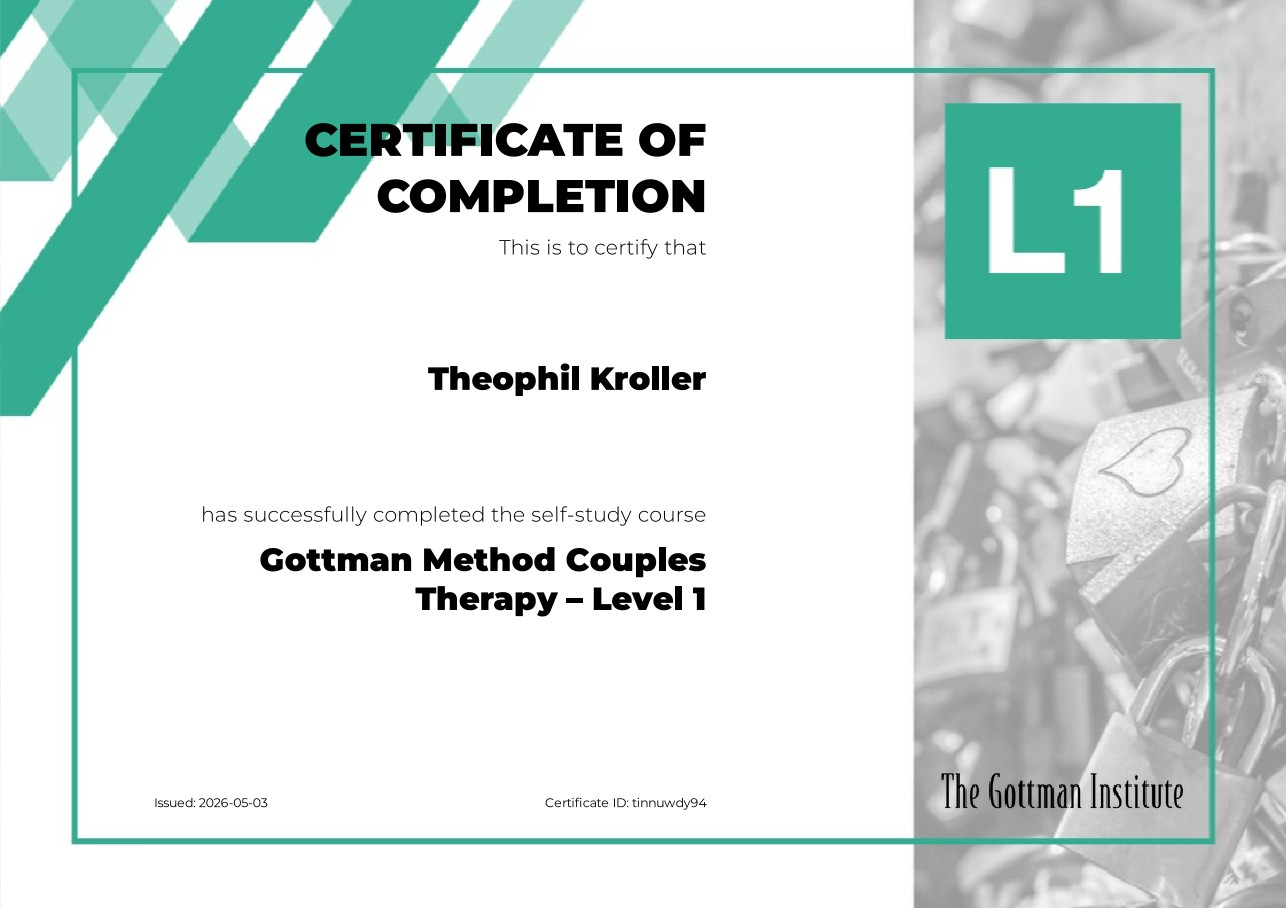
Gottman Method Couples Therapy Level 1
Training in couple dynamics, conflict patterns, friendship, trust and emotional connection.
Relational Life Therapy – Level 1 Training
Training in direct, relationship-focused work with couple dynamics, responsibility, boundaries and connection.
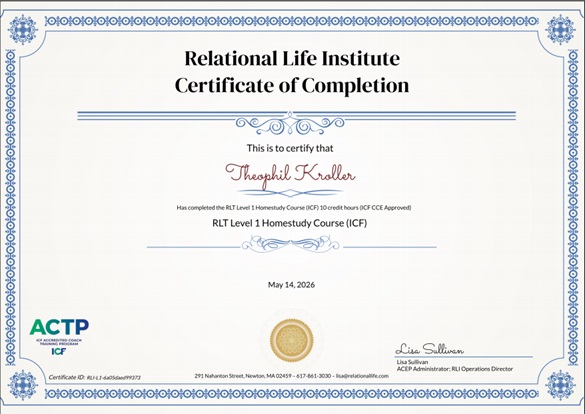
The trainings listed here refer to completed courses or training levels. They do not automatically imply certification as a therapist or licensed provider of the respective method.
Other seminars and learning spaces that have shaped my work ⌄
Infinite Body Immersion Course (2021–2022)
108-hour year programme on body awareness, movement, presence, expression and perception.
Seminars on body, intimacy and relationships (2022–2025)
Body awareness, mindful connection, intimacy, relationship dynamics, presence and communication.
Unlearning to Be (2022)
Self-awareness, inner patterns, presence and personal development.
Authentic Relating Level 1 (2023)
Authentic communication, honest expression, listening, empathy and contact.
Aggression and Life Force (2023)
Integrative Gestalt-based seminar on aggression, courage, vitality, boundaries and presence.
Seminars with Dr John Demartini (2020–2025)
More than 150 hours on values, perspective shifts, goals and structured self-reflection.
Bujinkan Budo Taijutsu
Long-term body practice centred on attention, grounding, boundaries, presence and space.
If you want to talk, we can talk.
You can arrive with a clear question or with a complete mess. In the first conversation, we work out what is going on and whether working together feels right for you.